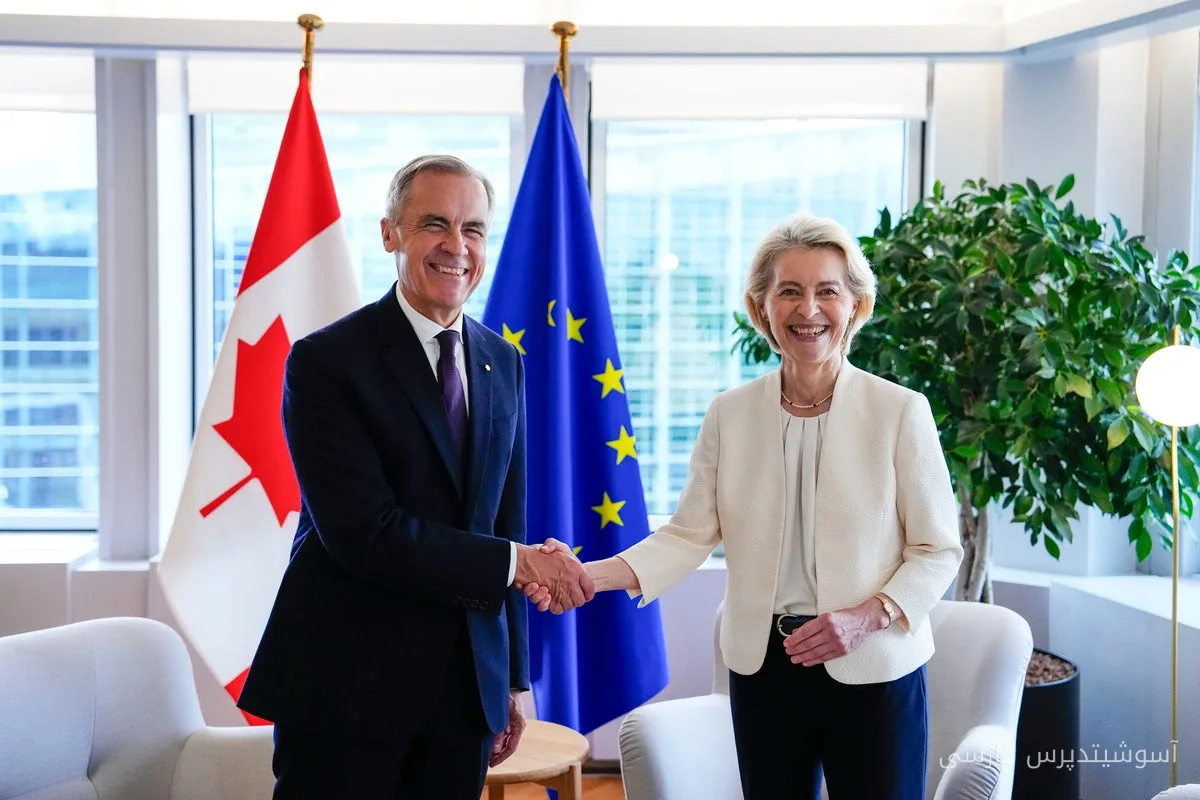
Ursula von der Leyen, President of the European Commission, has proposed that Canada be considered as the first associate member of the European Union. This proposal comes at a time when relations between Ottawa and its historical ally, Washington, are on the decline.
Canada's Efforts to Establish New Agreements
Mark Carney, Prime Minister of Canada, has announced that he is seeking to establish a "unique" agreement with the European Union. These efforts follow repeated threats from Donald Trump, President of the United States, against Canada's sovereignty. However, there is currently no official status of "associate member" in European Union treaties, and such an agreement would require significant changes to EU policies.
Read more: News helicopter crash in Los Angeles leaves three dead
Legal and Political Challenges
The "associate member" agreement does not have a clear definition in EU law, but it has been proposed in political discussions in recent years. In her annual speech on the state of the European Union, von der Leyen stated that she is willing to work with Carney to open the doors for Canada to enter this new status. These remarks come after days of discussion about a specific agreement, following Carney's announcement that he is seeking a unique agreement outside of full membership in the EU.
Furthermore, one EU diplomat expressed concern about the complexities of creating such an agreement, stating, "No one really knows what this means." He added that there are concerns that the President of the European Commission "is over-promising and may not be able to deliver." Additionally, the European Commission has emphasized that any solution must respect the nature of the "merit-based" accession process, and diplomats have argued that all treaties would need to be amended to comply with this agreement.
Efforts for Deeper Cooperation
This week, von der Leyen's remarks were welcomed, emphasizing that the EU must "immediately review its partnerships" and accept Canada as the "first associate member." She specifically noted that this partnership is not against anyone else and may be an attempt to anticipate negative reactions from President Trump. Both Canada and the EU are looking to strengthen cooperation to counter the economic dominance of the United States and China and to uphold democracy and a rules-based international order.
Australian Trade Minister Dan Tehan also stated that they are "on the same page" with Canada, although he did not provide clarification on whether Canberra is seeking deeper relations.
A Franco-German working group proposed a concept called "associate membership" in 2023 as part of institutional reforms aimed at expanding the EU by 2030. This report, which does not explicitly represent the official position of the French and German governments, suggests four levels of European integration.
These levels include (1) an inner circle of deep integration; (2) the EU itself; (3) a larger circle of "associate members"; and (4) a European political community, which operates in cooperation without adopting EU laws.
However, Canada and the EU currently have a trade agreement called CETA. More than a decade after the signing of this agreement and nine years since its provisional implementation, several EU countries have yet to ratify it. If Canada wishes to enter the EU single market, it must align its standards and regulations with EU laws.
If Canada enters the single market without full membership, it will become a "rule-taker" with no role in policymaking. However, the 2023 proposals indicate that they will not need to participate in deeper political integration in areas such as justice and internal affairs.
Read more: Saudi Arabia declares attempts to attack Mecca a red line · Trump announces plans to remove 15% tariff on Irish whiskey
Source: independent.co.uk